Vaccines, Autism & the Truth Parents Deserve: What Families in West Tennessee Should Know

Over the past few weeks, many parents across West Tennessee have reached out with the same question: “I heard the CDC shared something confusing about autism and vaccines—what does that mean for my child?”

It’s a reasonable question. Any time a major health organization publishes something that sounds unclear or contradicts years of medical guidance, families feel unsettled. Parenting is filled with enough worry already—nobody needs extra confusion about something as important as vaccines.

At The Children’s Clinic in Jackson, TN, we believe parents deserve calm, clear, and reliable information. And when it comes to vaccines and autism, the research has been consistent for decades: vaccines do not cause autism. That’s not an opinion. It’s not a trend. It’s not something that changes with a single online post. It is the conclusion of decades of careful, large-scale, peer-reviewed research involving millions of children around the world.

So let’s talk about what happened, why it matters, and how parents can move forward with confidence.

What Sparked the Concern?

Recently, the U.S. Centers for Disease Control and Prevention (CDC) added wording to one of its autism webpages that left room for misunderstanding. It wasn’t an official change to medical guidance. It wasn’t new evidence. It wasn’t based on updated science.

But it was vague enough to give the false impression that scientists were reconsidering the connection between vaccines and autism.

Parents noticed. Autism advocates noticed. Pediatricians across the country noticed. And the concerns grew quickly, especially online where misinformation spreads rapidly.

However, leading medical experts—including the American Academy of Pediatrics (AAP)—responded immediately. Their message was direct and reassuring:

Vaccines do not cause autism. They have never been shown to cause autism. The science on this is overwhelming.

Dr. Susan Kressly, president of the AAP, put it simply:
“Parents deserve peace of mind. Decades of rigorous research have shown vaccines do not cause autism.”

This statement echoes what pediatricians, neurologists, developmental specialists, and autism researchers have been saying for years.

How We Know Vaccines Don’t Cause Autism

Parents deserve more than a simple answer—they deserve to understand why the medical community is so confident.

Over the past several decades, scientists have examined this question from every angle imaginable:

  • Extremely large population studies comparing vaccinated children to unvaccinated children

  • Long-term developmental tracking

  • Genetic research

  • Neurological studies looking at how autism develops in the brain

  • Reviews of vaccine ingredients

  • Studies across different countries, ages, and health systems

Across all of that research, the result is always the same:

There is no link between vaccines and autism.

Not a weak link. Not a questionable link. Not a “possible” link.

No link.

Autism is a complex neurological condition with roots in early brain development, likely influenced by genetics and other non-vaccine-related factors. It does not come from vaccines, and it never has.

Where the Original Myth Came From

The idea that vaccines cause autism didn’t come from scientific discovery. It came from a single, deeply flawed paper published in 1998 that falsely claimed a connection between the MMR vaccine and autism.

That paper was later found to contain falsified data and undisclosed financial conflicts of interest. The journal that published it fully retracted it. The doctor behind it lost his medical license.

Yet, the rumor continued to spread—because fear spreads faster than facts.

Parents who lived through that era often still remember the headlines, even after the truth came out. This is why pediatricians have worked so hard to correct the misinformation. And why the AAP is pushing back once again today.

Why the AAP Spoke Up Now

The American Academy of Pediatrics, which represents over 67,000 pediatricians across the country, quickly responded to the recent CDC website issue. They issued a strong public statement reaffirming scientific evidence and expressing solidarity with the autism community.

The AAP made it clear:

- Vaccines do not cause autism

- Parents deserve accurate information

- Misinformation harms families and undermines health

Families who have autistic children have also been vocal about their frustration with vaccine myths. Many feel the rumor distracts from real support needs, real therapies, and real advocacy for autistic individuals.

The AAP has listened—and stood beside them.

Why This Matters for Families in West Tennessee

In communities like Jackson, Medina, Humboldt, Henderson, and the surrounding areas, parents rely heavily on trusted local providers. Most families want to do the right thing for their children. They don’t want to take unnecessary risks. They don’t want to skip something important. But they don’t want to be misled, either.

So when a national agency posts something confusing, it’s normal for families to ask questions.

At The Children’s Clinic, we want you to hear the reassurance directly:

Nothing has changed. Vaccines are still safe, recommended, and essential for keeping children healthy.

Vaccines protect children from illnesses that once caused severe complications, hospitalizations, and deaths.
They keep our West Tennessee schools healthier.
They protect newborns who are too young to be vaccinated.
They protect children with compromised immune systems.
They keep our hospitals from overwhelming winter surges.

Vaccines are one of the most successful public health tools we have ever had.

How Pediatricians Approach Autism Today

One of the reasons the vaccine myth is so harmful is that it distracts from what really supports autistic children: early identification, understanding, and proper services.

Autism is not a tragedy. It’s not something to blame on vaccines. It’s a neurodevelopmental difference—one that many children and adults navigate confidently with the right support.

Today’s pediatric care focuses on:

  • Early developmental screening

  • Listening to parents’ observations

  • Supporting children’s strengths

  • Connecting families with therapy and resources

  • Creating inclusive, accessible environments

  • Advocating for education and community support

When the public clings to myths, it hurts autistic individuals by perpetuating stigma or dismissing their lived experiences.

This is why the AAP and autism advocates were so quick to call attention to the misleading CDC wording—because correcting misinformation benefits every family.

Why Vaccine Confidence Matters Now More Than Ever

We live in a time when information travels fast, but not always accurately. One mistaken phrase, taken out of context, can spread across social media before experts have a chance to correct it. And when misinformation spreads about vaccines, it impacts everyone.

In recent years, we have seen:

  • Measles outbreaks in communities with low vaccination rates

  • Whooping cough resurgences

  • Influenza seasons affecting younger children more severely

  • RSV and viral surges leading to overwhelmed pediatric hospitals

Vaccines remain the most reliable way to protect children from these threats. When families hesitate because of misinformation, entire communities become more vulnerable.

That’s why having trusted, science-based support from pediatricians matters so much—especially in regions like West Tennessee, where families rely heavily on local providers and relationships built on trust.

Talking to Your Pediatrician Should Always Be the First Step

If you are unsure, confused, or simply want reassurance, your pediatrician is the best person to talk to. They know your child, your family, your concerns, and the health trends in our area.

At The Children’s Clinic in Jackson, we welcome every question. Nothing is too small, too specific, or too repetitive. Whether you want to discuss the vaccine schedule, ingredients, safety studies, autism research, or your child’s development, our team is here to guide you.

You deserve answers based on evidence—not rumors. And you deserve those answers from someone who knows your family.

Final Thoughts: Parents Deserve Peace of Mind

Parents today make hundreds of decisions a week. Some are small. Some feel enormous. Vaccines shouldn’t have to be a source of fear or confusion.

The science is clear and reassuring.
The experts are united.
Your pediatricians stand firmly behind the evidence.
And your community—especially the autism community—deserves better than misinformation.

Vaccines do not cause autism.
They protect children.
They save lives.
And they help our West Tennessee families thrive.

If you ever have questions, we are here to help—always.

📍 The Children’s Clinic
264 Coatsland Drive
Jackson, TN 38301

📞 731-423-1500

Proudly caring for families across Jackson, Medina, Humboldt, Henderson, Lexington, and the greater West Tennessee region.
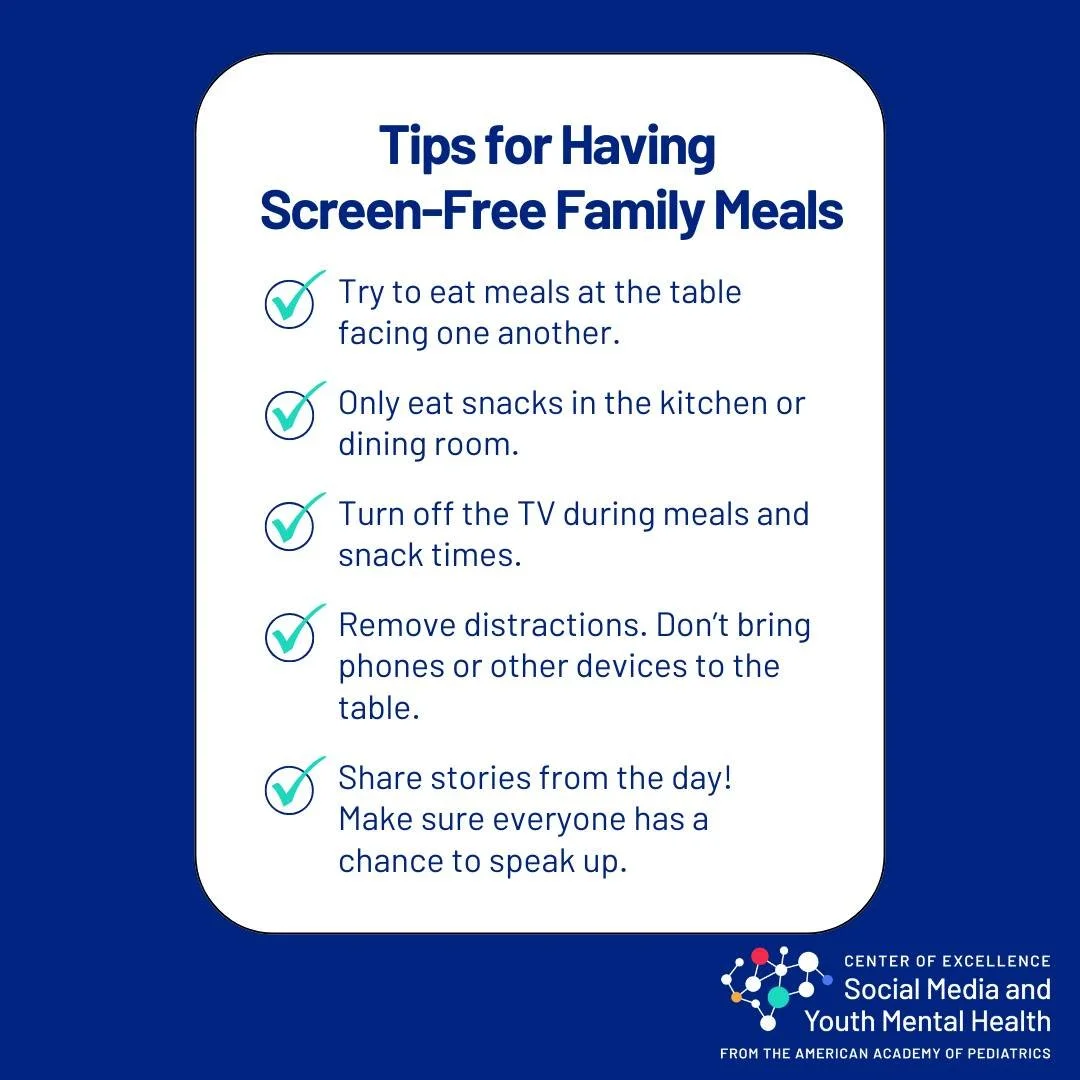
Screens Down, Family Up: How Screen-Free Dinners Help Kids Thrive in West Tennessee

Most families today eat dinner with at least one screen glowing nearby—whether it’s a TV running in the background, a cell phone buzzing on the table, or a tablet propped in front of a child to keep them still long enough to finish a meal. It’s part of modern life, and no parent should feel guilty about it.

But something pretty remarkable happens when families set aside screens, even just a few nights a week, and eat together with no digital interruptions. Kids open up. Parents unwind. And conversations that rarely happen during busy days suddenly have space to grow.

At The Children’s Clinic in Jackson, TN, we talk often with parents about the everyday habits that support children’s emotional and developmental health. One of the simplest—and most overlooked—is sitting down together for even one screen-free meal. Families across West Tennessee are surprised by how manageable and meaningful this small shift can be.

If you’ve been trying to get your family back around the table, here’s a warm, realistic, down-to-earth guide to making screen-free dinners a lasting routine.

🌤️ Why Family Dinners Matter More Than Ever

Family dinners aren’t about food—they’re about connection. And connection is something kids need just as much as nutrition, sleep, and physical activity.

Even two or three shared meals each week can help children:

  • Build stronger communication skills

  • Feel more secure and grounded

  • Develop confidence speaking with adults

  • Form healthier eating habits

  • Cope better with stress or emotional challenges

  • Strengthen their sense of belonging within the family

Researchers have found that children who share regular meals with their family often show better academic performance, fewer behavior struggles, and stronger emotional resilience.

And those benefits show up no matter what’s on the table—homemade soup, takeout pizza, chicken nuggets, or cereal for dinner. The magic isn’t the menu. It’s the togetherness.

📱 When Screens Take Over the Table

Screens aren’t the enemy here. They help with homework, allow grandparents to FaceTime from across the country, entertain children during long errands, and keep parents connected for work.

The issue is distraction.

When screens are on during meals, kids tend to:

  • Withdraw and talk less

  • Eat too quickly or too little

  • Pay less attention to fullness cues

  • Miss valuable back-and-forth conversation

  • Disconnect from their own family members

And parents miss out too. Instead of learning how their child’s day went or what they’re worried about, it becomes easy to zone out, scroll, or try to multitask.

This is why pediatricians encourage families to reclaim even a little screen-free time. Not all meals. Not every day. Just enough to keep relationships strong.

🌿 How to Start a Screen-Free Dinner Habit Without a Battle

You don’t have to launch a full-scale “no screens ever” rule. Small tweaks work best—especially with young children or busy schedules.

Here’s how families in Jackson, Medina, Humboldt, Henderson, and the surrounding West Tennessee communities have made this practical:

1. Begin with just two screen-free dinners a week.

Choosing nights that already feel calmer gives you a better chance of sticking with the routine.

2. Set expectations early in the day.

A simple heads-up like:
“Tonight is one of our screen-free dinners, okay?”
helps kids transition smoothly.

3. Use a phone basket or designated drop spot.

Everyone (even the grown-ups!) places their devices in the basket before sitting down. Out of sight really is out of mind.

4. Keep meals simple on screen-free nights.

Make it easy on yourself.
Leftovers, sandwiches, pasta, rotisserie chicken—whatever is low effort works perfectly.

5. Let kids help in small ways.

Children who help even a little feel more connected to the meal.
Ideas:

  • Placing napkins on the table

  • Washing fruit

  • Stirring something

  • Choosing the music (soft background music is okay!)

6. Have gentle conversation starters ready.

These help break the ice, especially with older kids:

  • “What made you laugh today?”

  • “What was one hard thing and one good thing from your day?”

  • “If you could create a new school rule, what would it be?”

  • “What’s something you’re looking forward to?”

7. Keep expectations age-appropriate.

Toddlers may not sit still long. Teens may be reserved at first. That’s normal. The goal is connection, not perfection.

🌈 What Screen-Free Meals Look Like in Real Families

A lot of parents imagine screen-free dinners require a perfectly calm household, long meaningful conversations, or gourmet cooking. In real life, it looks much simpler.

In homes across West Tennessee, screen-free meals look like:

  • A toddler eating three bites and wanting down.

  • A five-year-old telling endless stories about school.

  • A teenager rolling their eyes at first—but staying to talk longer than expected.

  • Parents eating in shifts between after-school activities—and still having five minutes together.

  • Laughter, spills, interruptions, and moments of connection tucked in between.

Family meals don’t have to be quiet or polished to matter. They just have to happen.

🧠 The Developmental Benefits You Don’t See Right Away

Kids might not say, “Thank you for helping me develop social skills at dinner tonight!”
But parents often notice subtle shifts:

Kids become more talkative and expressive.

Even small children learn how to share stories, take turns speaking, and stay engaged.

Eating habits improve naturally.

Without a screen, children learn to slow down and notice hunger and fullness cues.

Family relationships strengthen.

Kids feel seen, heard, and supported—something that’s especially important during stressful school periods or developmental transitions.

Parents get a clearer sense of their child’s emotional world.

Screen-free dinners give adults a window into what their children are thinking, struggling with, or excited about.

🥗 Simple Ways to Make Screen-Free Meals Fun

Some families like to build small traditions that kids look forward to. Here are a few ideas that work well:

• “Rose, Thorn, Bud”

Each person shares:

  • A Rose — something good from their day

  • A Thorn — something challenging

  • A Bud — something they’re excited about

• The “Choose the Vegetable” Night

Let one child pick the veggie for dinner. Kids love the control, even if they choose something funny like peas and pickles.

• Theme Nights

Not every week, but once in a while:

  • Taco Tuesday

  • Breakfast for Dinner

  • Pasta Night

  • “Build Your Own” bowls or sandwiches

• Dinner Music Playlist

Kids can choose soft background music that fits the vibe.

• Story-from-the-Day Sharing

Each person shares something from their day—even small things count.

🌙 When the Routine Starts to Stick

After a few weeks, many families notice:

  • Less arguing

  • Less rushing

  • Kids opening up more

  • More laughter

  • A calmer evening rhythm

It doesn’t happen overnight, but small, steady habits become natural family anchors. Parents often tell us their kids eventually begin reminding them it’s a screen-free dinner night.

👶 Why Pediatricians Recommend Family Meals

At The Children’s Clinic in Jackson, TN, we care deeply about supporting the whole child—emotionally, socially, and physically. Strong family connections play an enormous role in setting children up for long-term well-being.

Pediatricians recommend screen-free dinners because they support:

  • Healthy emotional regulation

  • Better behavior

  • Stronger communication skills

  • Social development

  • Lower stress levels

  • Healthier eating and growth

  • A stable sense of family identity

It’s one of the easiest, most meaningful habits a family can build—no special equipment, schedules, or costs required.

🏡 Final Thoughts: Start Small, Stay Consistent, and Enjoy the Moments

You don’t need a perfect household, perfect timing, or perfect meals. A few nights a week is enough to make a real difference. What matters most is the intention behind it: to slow down, connect, listen, and be fully present with the people who matter most.

Even on the busiest days, children feel the difference. They notice when you’re truly focused on them. And the moments you create around the table today become the memories they carry forward into adulthood.

If you ever have questions about healthy routines, child development, eating habits, or screen use, the pediatricians at The Children’s Clinic are always here to help.

📍 The Children’s Clinic
264 Coatsland Drive
Jackson, TN 38301

📞 Phone: 731-423-1500

Serving families throughout Jackson, Medina, Humboldt, Henderson, and the entire West Tennessee region, The Children’s Clinic provides compassionate, evidence-based pediatric care from infancy through adolescence.

For more information on healthy habits and screen-time guidance, visit:
https://www.aap.org/EarlyChildhoodScreenTime

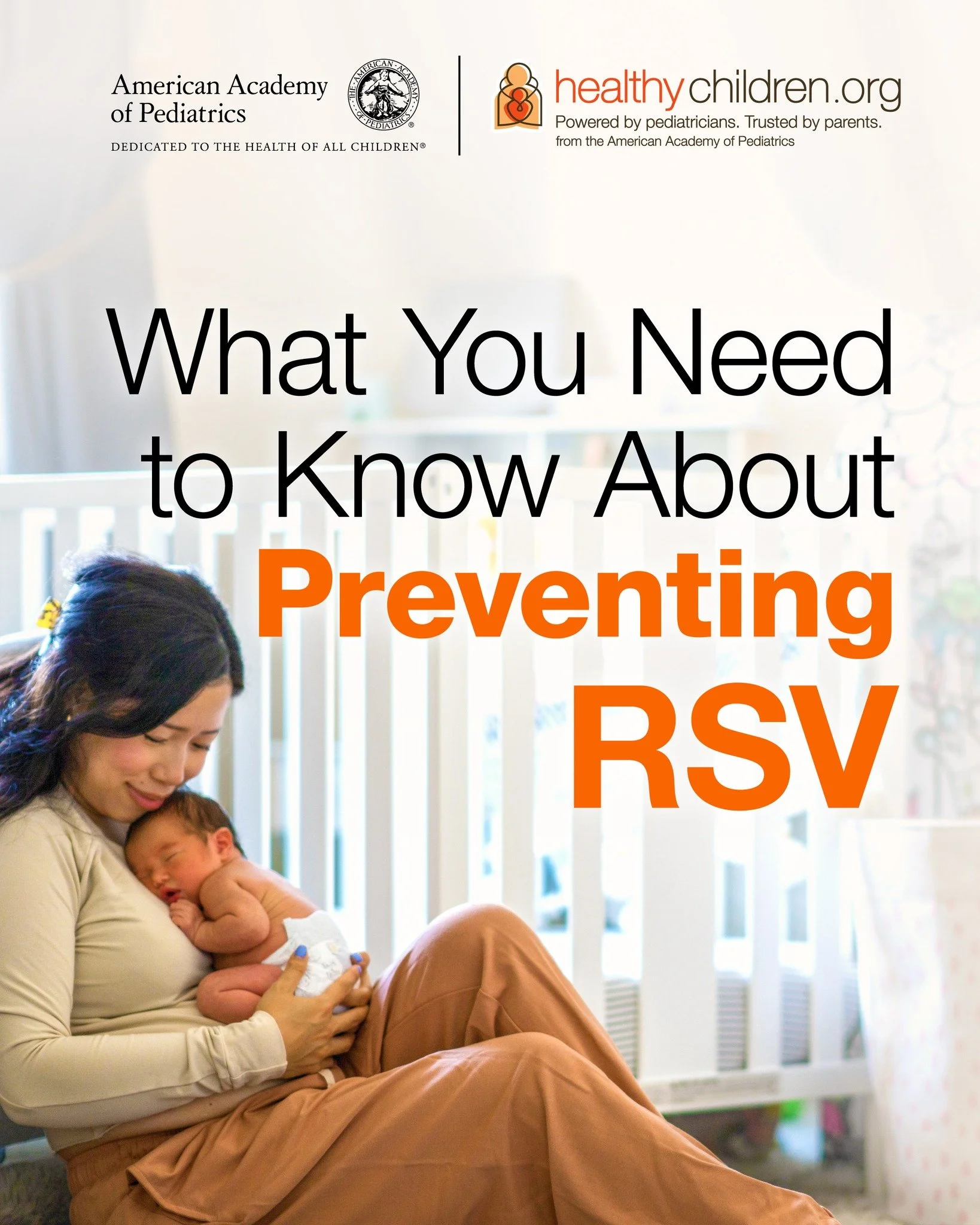
Protecting Your Baby From RSV: What West Tennessee Parents Need to Know This Season

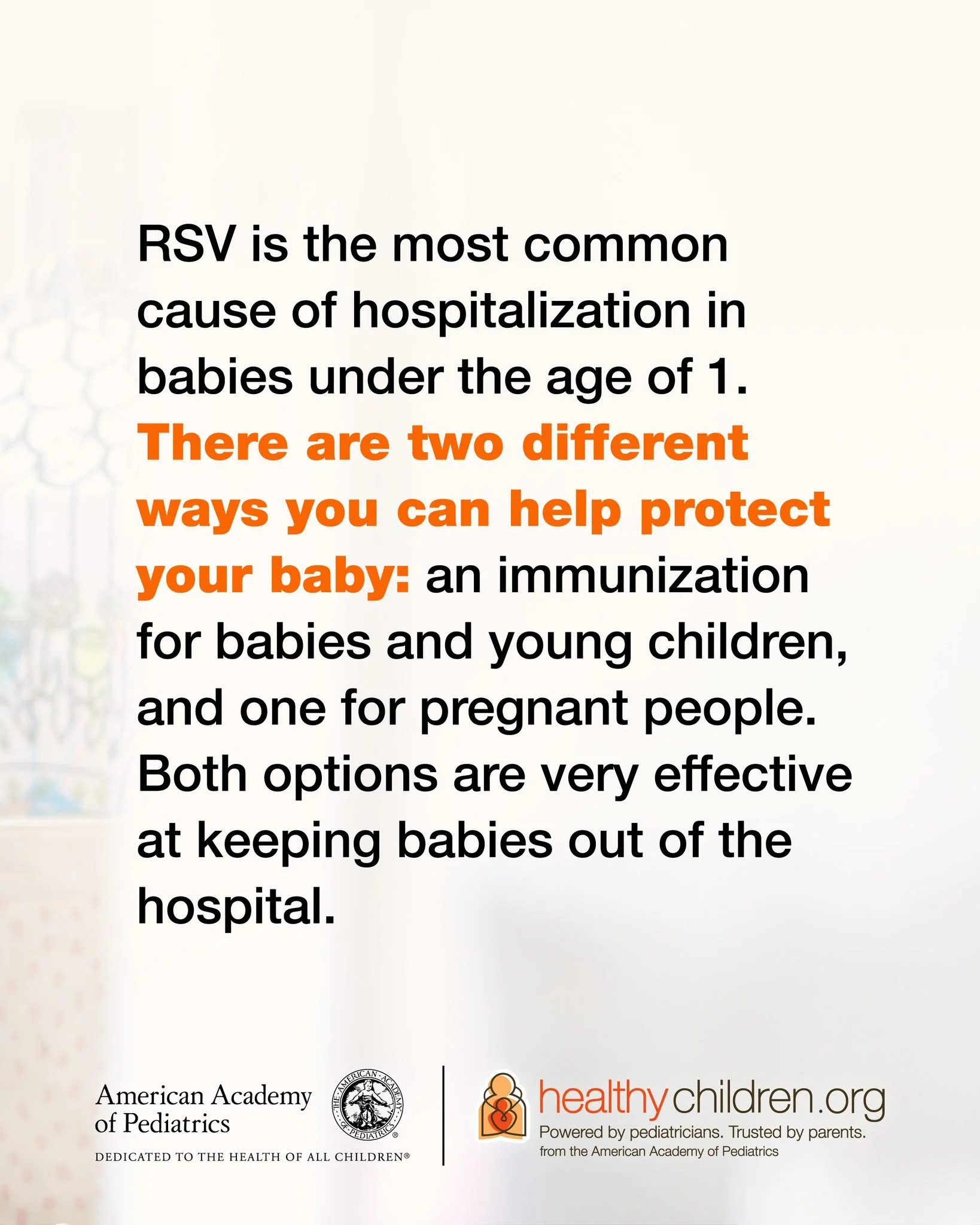
Every parent knows how quickly a sniffle can send the whole household into panic—especially when it comes from a baby who can’t tell you what hurts. And while most colds come and go without causing much disruption, RSV is a different story. Respiratory syncytial virus is extremely common, incredibly contagious, and, for babies under one, the leading cause of hospitalization in the United States.

Here in Jackson, TN, pediatricians at The Children’s Clinic see a surge of RSV cases every fall and winter. It’s part of the seasonal rhythm, much like influenza and other viral illnesses. But RSV deserves special attention because of how quickly it can affect a baby’s breathing.

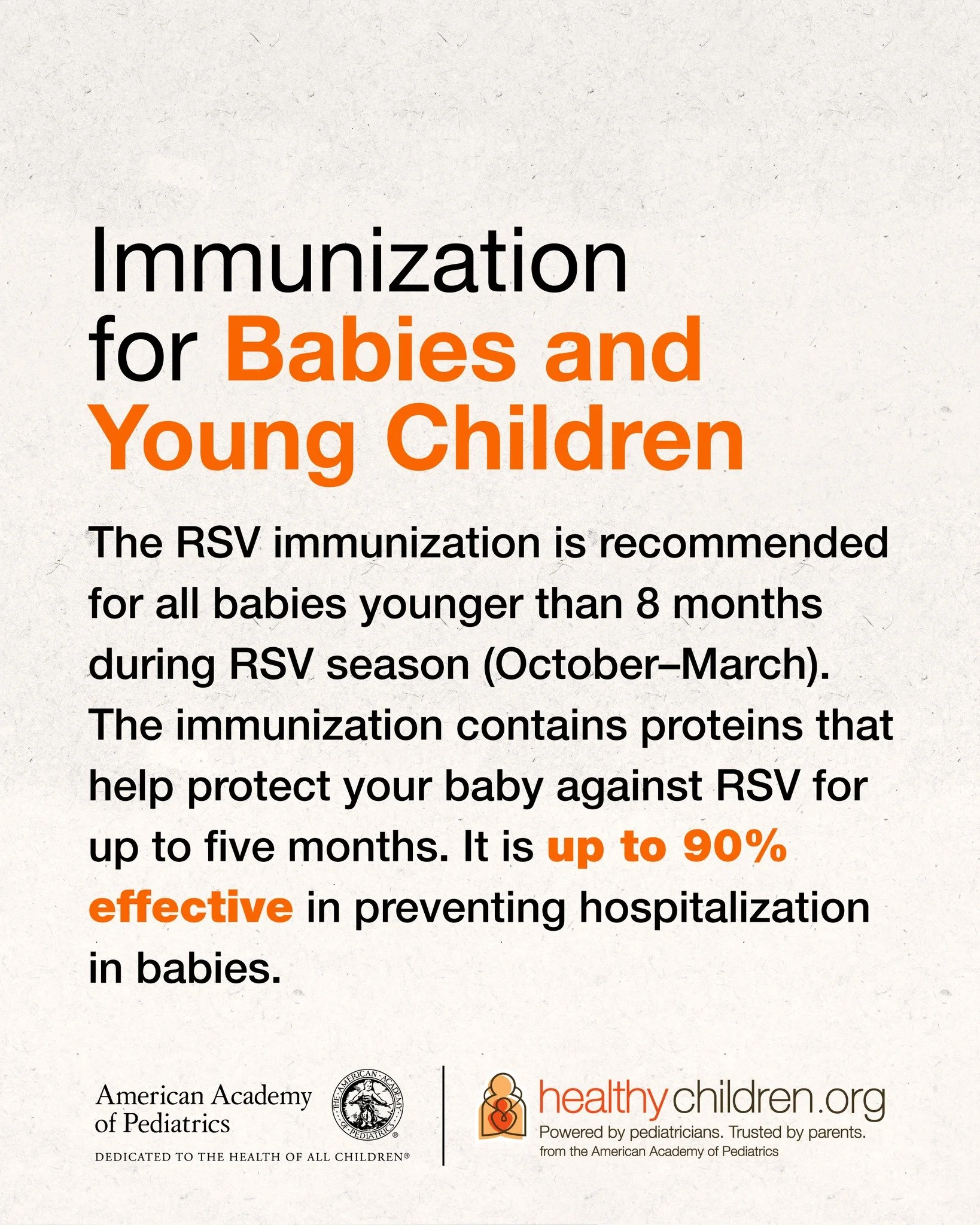
The reassuring news? We now have two proven immunization options that help protect infants during RSV season. These tools have dramatically changed the way doctors can shield newborns and young babies from severe illness. And for families across West Tennessee—Jackson, Henderson, Medina, Humboldt, and beyond—this information can make a real difference in keeping your baby safe.

This guide breaks down exactly what RSV is, why it’s so concerning, and how the two RSV immunizations work. If you’re a new parent or expecting a newborn soon, this is your go-to resource.

Understanding RSV: Why It Hits Babies So Hard

RSV isn’t new. Most adults have had it countless times in their lives, often confusing it with a routine cold. But babies—especially those under six months—don’t have the immune strength or airway size to handle the virus as easily. Even a small amount of inflammation can make breathing difficult.

Symptoms of RSV in Babies May Include:

  • Rapid or labored breathing

  • Wheezing

  • Flaring nostrils

  • Trouble feeding (because breathing and eating at the same time becomes hard)

  • Persistent cough

  • Fever

  • Lethargy or unusual fussiness

In severe cases, babies can experience dehydration, low oxygen levels, and respiratory distress. RSV can progress fast, which is why pediatricians warn parents to keep a close eye on symptoms.

Why RSV Season Matters

In West Tennessee, RSV typically peaks between October and March, though recent years have shown unpredictable surges. Hospitals across the country, including those that serve the Jackson area, often fill with infants struggling to breathe during these months.

This is why prevention is so important—and why the new RSV immunizations have made such a meaningful impact.

Two Immunization Options: What Actually Protects Your Baby

There are two types of RSV immunizations available, each designed for different situations:

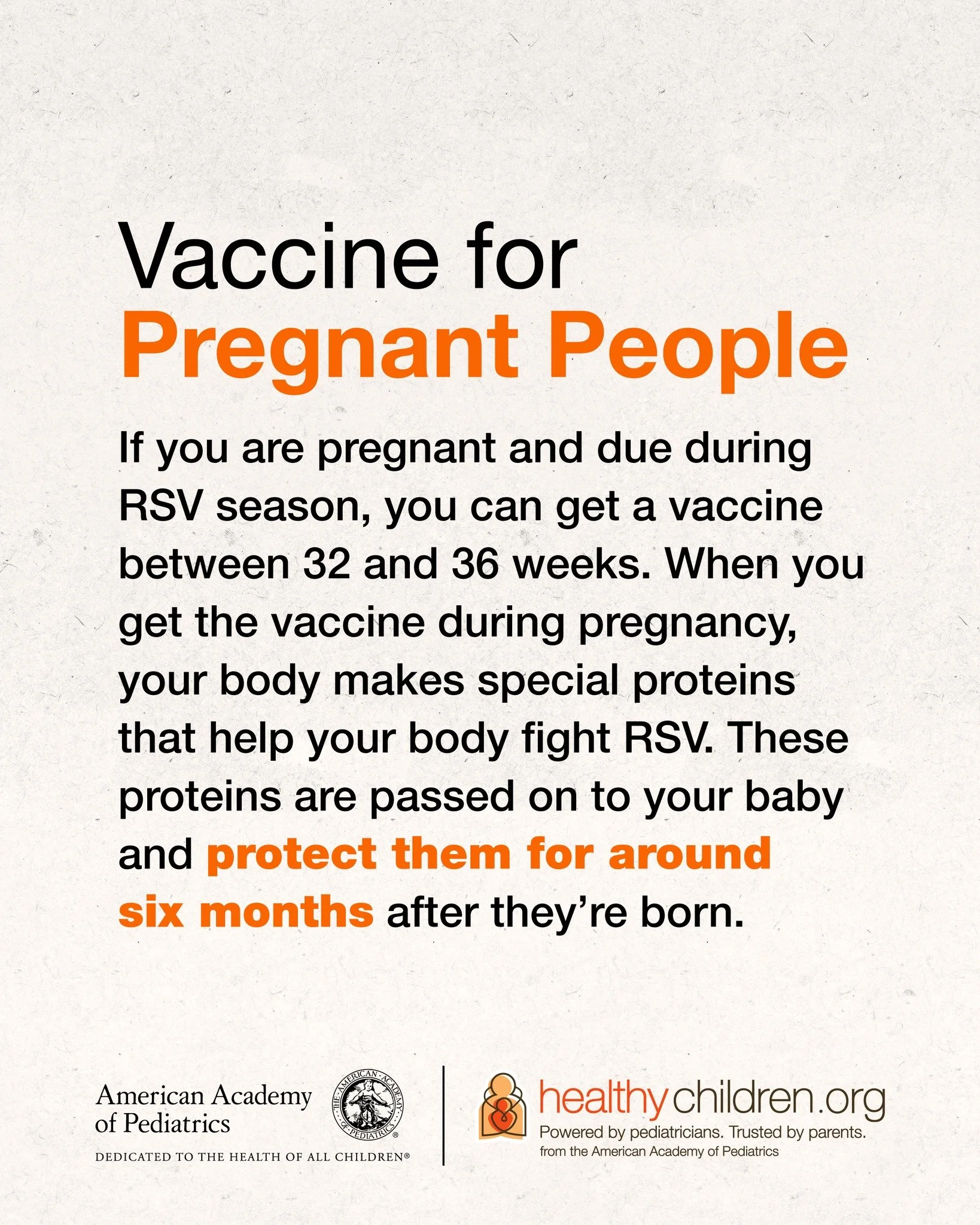
1. A Maternal RSV Vaccine (Given During Pregnancy)

This vaccine is administered to pregnant women—usually during the third trimester. When mothers receive it, they transfer protective antibodies through the placenta directly to their baby. That means the baby is born with built-in defense against RSV during the first vulnerable months of life.

2. An Infant Monoclonal Antibody Shot

This is not a vaccine in the traditional sense. Instead, it is a direct dose of RSV-fighting antibodies given to the baby after birth. Babies don’t have to “learn” immunity—it is provided directly and immediately.

The monoclonal antibody option is especially helpful for:

  • Babies born during RSV season

  • Babies whose mothers didn’t receive the prenatal RSV vaccine

  • Premature infants

  • Infants with heart or lung conditions

  • Babies at higher medical risk for complications

Both options are safe, thoroughly tested, and recommended by pediatric experts including the American Academy of Pediatrics.

Your pediatrician at The Children’s Clinic in Jackson can help determine which one is appropriate for your baby’s age, health history, and season of birth.

How These Immunizations Protect Your Baby

RSV isn’t something you can fully avoid. Even families who stay home, sanitize toys, wash hands religiously, and limit public outings can still be exposed. RSV spreads easily through:

  • Tiny droplets from coughs or sneezes

  • Surfaces like toys, doorknobs, strollers, or shopping carts

  • Close contact with siblings who bring home germs

  • Public spaces—even brief visits

Because of how contagious RSV is, doctors focus less on avoiding exposure entirely and more on reducing the severity of illness. That’s exactly what immunizations do.

Immunization Doesn’t Eliminate RSV—It Reduces the Danger

Most babies who receive RSV protection still may get the virus at some point. The key difference is how sick they get. Studies show that these immunizations dramatically reduce:

  • Hospitalizations

  • ER visits

  • Severe breathing trouble

  • Need for oxygen support

For many families, this means fewer sleepless nights, far less stress, and safer winter months.

What Parents in Jackson, TN Should Do Before RSV Season

If you’re expecting a baby:

Talk to your OB-GYN about the maternal RSV vaccine.

This ensures your baby starts life with immediate protection. Babies born in fall or winter especially benefit, since RSV circulation is highest during these months.

If you have a newborn or young infant:

Ask your pediatrician whether your baby qualifies for the RSV monoclonal antibody shot.

This is especially important for:

  • Babies under 8 months

  • Premature infants

  • Babies with underlying medical conditions

At The Children’s Clinic, pediatricians guide parents through the timing, eligibility, and benefits of each option.

Frequently Asked Questions From Local Parents

After years of uncertainty surrounding viruses and seasonal illnesses, many West Tennessee parents have specific questions. Here are some of the most common:

“My baby seems healthy—do they really need RSV protection?”

Yes. Even babies with no medical issues can become seriously ill. RSV is unpredictable, and even full-term infants can struggle with breathing once the infection hits.

“Can babies get RSV more than once?”

Absolutely. Immunity after infection is not strong or long-lasting. This is why prevention each season matters.

“Does breastfeeding protect my baby from RSV?”

While breastfeeding helps support overall immunity, it does not provide targeted protection against RSV.

“Is the RSV shot the same thing as a vaccine?”

The infant shot is technically an antibody treatment, not a vaccine, but both approaches are considered preventive immunizations.

“When should I call my pediatrician?”

Call immediately if your baby shows:

  • Rapid breathing

  • Blue lips or fingernails

  • Difficulty feeding

  • Dehydration

  • Extreme fatigue

  • Wheezing

Quick medical evaluation is crucial.

Why Local Clinics Like Ours Support RSV Immunization

At The Children’s Clinic in Jackson, we have cared for West Tennessee families for generations. We’ve seen firsthand how quickly RSV can escalate, especially in babies who were perfectly healthy the day before.

With the arrival of these new immunizations, pediatricians finally have reliable tools to offer parents—tools that significantly reduce the chance of emergency hospital visits.

We believe in offering families clear, compassionate guidance. That means explaining your baby’s options in plain language, answering your questions openly, and supporting your decisions with evidence-based recommendations.

You know your baby best. We’re simply here to help you protect them.

How to Keep Your Baby Safer at Home and in Public

Immunizations are the strongest defense against RSV, but everyday prevention still plays a role:

Wash hands frequently

RSV spreads easily through touch.

Limit exposure to large gatherings

Especially during the peak of RSV season.

Avoid letting strangers touch your baby’s hands or face

Even well-meaning visitors can unintentionally spread germs.

Clean surfaces and toys often

RSV can survive for hours on hard surfaces.

Keep older siblings home when sick

School-aged children are the biggest source of exposure.

Never hesitate to call your pediatrician

It’s always better to ask early than wait.

These small habits work together with immunizations to create a much safer environment for your baby.

The Bottom Line: RSV Is Common—But Hospitalization Doesn’t Have to Be

RSV is part of every baby’s world, whether we like it or not. But the difference between mild congestion and a frightening hospital stay often comes down to prevention. Thanks to medical advancements, families now have options that didn’t exist just a few years ago.

Whether your baby receives immunity through the maternal vaccine or through the infant antibody shot, the goal is the same:
keep them safe, breathing comfortably, and growing without disruption.

As RSV season approaches, the team at The Children’s Clinic is here to guide you through every step—answering questions, reviewing eligibility, and providing the best recommendations for your child’s health.

Call The Children’s Clinic in Jackson, TN for Guidance on RSV Protection

If you’re unsure whether your baby needs RSV immunization—or simply want to understand your options—we’re here to help. Our physicians are trained in the most up-to-date RSV prevention guidelines and can give personalized recommendations based on your baby’s age, health, and risk factors.

📍 The Children’s Clinic
264 Coatsland Drive
Jackson, TN 38301

📞 Phone: 731-423-1500

Families throughout Jackson, Medina, Humboldt, Henderson, Lexington, and West Tennessee trust us for clear guidance, compassionate pediatric care, and evidence-based recommendations.

If you have questions about RSV—or want to schedule your baby’s immunization—give us a call today. Your baby’s lungs, immune system, and future health depend on the decisions you make now. We’re honored to help you make those decisions with confidence.

Why Measles Still Matters: How the MMR Vaccine Keeps Kids Healthy in Jackson, TN

For many parents today, measles might seem like a disease from another era — something that belonged to the days before modern medicine, when even a simple illness could turn serious. But measles hasn’t disappeared. In fact, outbreaks have popped up across the country in recent years, often in communities where vaccination rates have dropped.

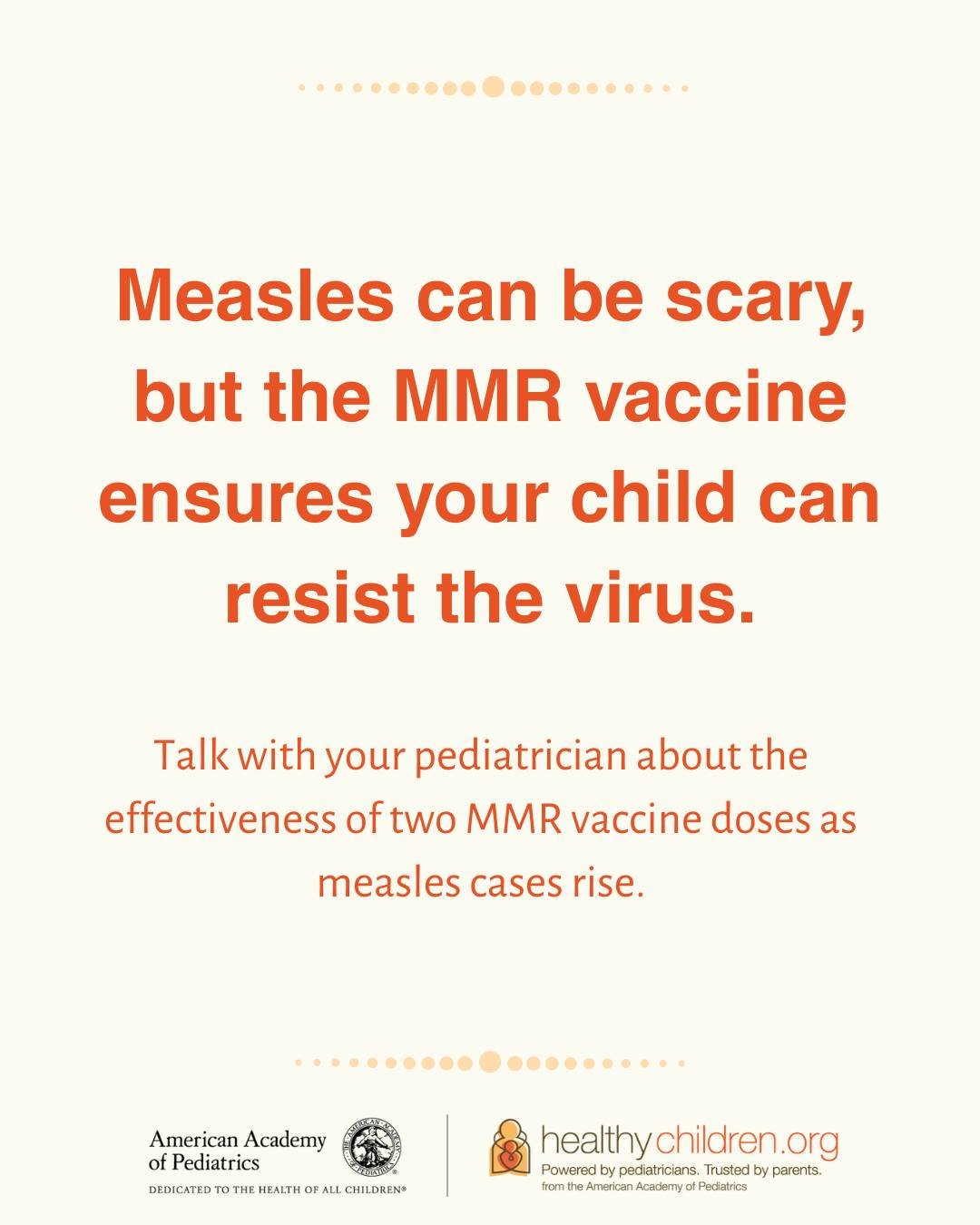
The good news is that this disease is almost entirely preventable. The MMR vaccine, which protects against measles, mumps, and rubella, has been safely used for decades and remains one of the most effective tools for protecting children’s health.

At The Children’s Clinic in Jackson, TN, we know that parents want trustworthy, clear information about vaccines so they can make the best decisions for their families. Let’s take a closer look at why measles prevention still matters — and how vaccination helps keep your child, and the entire West Tennessee community, safe and thriving.

What Is Measles?

Measles is a highly contagious viral illness caused by the rubeola virus. It spreads through the air when an infected person coughs, sneezes, or even talks. The virus can linger in the air or on surfaces for up to two hours — meaning it doesn’t take direct contact for someone to get sick.

Once a person is exposed, measles spreads quickly. In fact, one person with measles can infect up to nine out of 10 unvaccinated people they come into contact with. That’s how contagious it is — making it one of the most infectious diseases known.

Common Symptoms Include:

  • High fever (often 104°F or higher)

  • Cough

  • Runny nose

  • Red, watery eyes

  • Tiny white spots inside the mouth (called Koplik spots)

  • A full-body rash that appears several days after the fever

While most children recover, measles can lead to serious complications — especially in babies, young children, and those with weakened immune systems. Complications can include pneumonia, brain swelling (encephalitis), and even death.

Before the vaccine was introduced in 1963, measles infected about 3 to 4 million Americans every year, hospitalizing nearly 50,000 and killing around 500 annually. Thanks to vaccination, those numbers have dropped dramatically — but the virus still exists, and it can resurface quickly when vaccination rates decline.

Why Measles Outbreaks Still Happen

You might wonder: if we have an effective vaccine, why do we still hear about measles in the news?

The answer comes down to immunity gaps — areas where not enough people are vaccinated to stop the virus from spreading. Measles is so contagious that it requires about 95% of a community to be immunized in order to prevent outbreaks.

When vaccination rates dip, measles finds an opening. International travel can also play a role — someone who picks up the virus abroad can unknowingly bring it home and spread it to others who aren’t protected.

The CDC reports that in recent years, measles outbreaks have reappeared in pockets of the U.S., reminding us how crucial continued vaccination is. Fortunately, these outbreaks can be stopped quickly when communities maintain high immunization rates.

How the MMR Vaccine Works

The MMR vaccine protects against measles, mumps, and rubella in one shot. It contains weakened forms of these viruses, which safely teach your child’s immune system how to recognize and fight the real thing.

When the immune system “practices” this response, it develops long-term memory — meaning if your child is ever exposed to measles later in life, their body will immediately know how to fight it off.

The Recommended Schedule

  • First dose: 12–15 months of age

  • Second dose: 4–6 years of age

Two doses of the MMR vaccine are 97% effective at preventing measles. That’s nearly complete protection — one of the best success rates of any vaccine ever developed.

If your child missed a dose or is behind schedule, your pediatrician can help you get caught up safely.

Is the MMR Vaccine Safe?

Yes — the MMR vaccine is one of the most thoroughly studied and monitored vaccines in history. It’s been used for more than 50 years, and extensive research has consistently shown that it’s both safe and effective.

The most common side effects are mild and temporary:

  • Slight fever

  • Mild rash

  • Soreness at the injection site

Serious side effects are extremely rare. The risks of the disease itself are far greater than the minimal risks of the vaccine.

At The Children’s Clinic, our pediatricians take every precaution to ensure your child’s vaccines are administered safely and comfortably. We also make time to answer any questions you might have — no matter how small — so you can feel confident about your child’s care.

What Happens If Measles Returns to Our Area?

If measles were to reach Jackson or the surrounding West Tennessee area, unvaccinated individuals would be at the highest risk. Because the virus spreads through the air, even brief exposure in places like schools, churches, or grocery stores could lead to rapid transmission.

Children who haven’t received both doses of the MMR vaccine may be required to stay home from school during an outbreak to prevent further spread. This can disrupt education, work, and family routines.

Vaccination doesn’t just protect your child — it protects the entire community. When most people are immunized, the virus struggles to spread. This concept, known as herd immunity, helps protect vulnerable groups like newborns, cancer patients, and those who can’t receive vaccines for medical reasons.

Measles Myths and Facts

Unfortunately, misinformation about vaccines has spread almost as quickly as the diseases they prevent. Let’s separate myth from fact.

Myth 1: Measles isn’t serious.

Fact: Measles is a serious, sometimes deadly illness. Before vaccines, hundreds of children in the U.S. died every year. Complications like pneumonia or brain inflammation can cause lifelong disabilities.

Myth 2: The MMR vaccine causes autism.

Fact: This claim originated from a single discredited study in 1998 that was later proven fraudulent. Dozens of large-scale studies involving millions of children have found no link between vaccines and autism.

Myth 3: Natural infection provides better immunity.

Fact: While it’s true that infection can create immunity, the risks far outweigh the benefits. Measles can cause hospitalization, neurological damage, or death — risks that are easily avoided through vaccination.

Myth 4: We don’t need vaccines anymore.

Fact: Measles still exists globally. Travel and lower vaccination rates can bring it back at any time. Vaccines are the reason we rarely see these diseases, not the other way around.

Why Local Pediatricians Recommend MMR

At The Children’s Clinic in Jackson, our doctors follow the American Academy of Pediatrics (AAP) and Centers for Disease Control and Prevention (CDC) immunization guidelines. These organizations base their recommendations on decades of scientific research and global data.

When we recommend vaccines like MMR, it’s because we’ve seen firsthand how well they work — and how dangerous these illnesses can be when prevention is ignored.

We also understand that every family’s situation is unique. Some children have allergies or health conditions that require special considerations. That’s why we encourage open, judgment-free conversations. We’ll take the time to discuss your concerns, explain how vaccines work, and ensure your child’s care plan fits their specific needs.

What To Do If You’re Unsure About Your Child’s Vaccine Record

If you’re not sure whether your child is fully up to date on their MMR shots, your pediatrician can easily check their vaccination record.

In Tennessee, schools and childcare centers require proof of immunizations, including MMR, before enrollment. However, if you’ve moved recently or switched healthcare providers, there may be gaps or missing records.

Our team can:

  • Review your child’s immunization history

  • Help you locate past vaccine records

  • Schedule any catch-up shots needed

  • Provide official documentation for school or daycare requirements

We make the process simple and stress-free so that your child stays protected and compliant with state health regulations.

What Parents in Jackson, TN Should Know

In West Tennessee, pediatricians have seen increasing questions about vaccine safety, especially as misinformation circulates online. Our local health providers — including those at The Children’s Clinic — are committed to sharing accurate, science-based information with families.

Vaccines like the MMR are one of the cornerstones of public health. They not only keep individual children healthy but also ensure that diseases like measles don’t disrupt schools, workplaces, or entire communities.

If you’re planning a well-child visit soon, that’s the perfect time to ask about your child’s vaccine schedule. We’ll review what’s due, discuss any concerns, and provide the information you need to make the right decision.

Real Protection, Real Results

Since the introduction of the MMR vaccine, measles cases in the United States have dropped by more than 99%. Millions of lives worldwide have been saved by vaccination efforts.

That level of success is remarkable — and it’s something worth preserving. But to keep those numbers low, vaccination rates have to stay high. When families choose to vaccinate, they help protect not just their own children, but their neighbors, classmates, and entire communities.

In places like Jackson, where families are connected through schools, churches, and sports teams, that shared protection makes all the difference.

When To Call Your Pediatrician

If your child hasn’t yet received their MMR vaccine, or if you’re not sure whether they’re fully protected, it’s a good idea to reach out to your pediatrician. The earlier children get vaccinated, the better protected they are from exposure in daycare, school, or public spaces.

If your child develops symptoms like fever, rash, or red eyes and you suspect exposure to measles, contact your doctor immediately. Early evaluation helps prevent the virus from spreading to others.

At The Children’s Clinic, we’re always here to help answer your questions — whether it’s about vaccines, nutrition, growth milestones, or illness prevention.

A Healthy Future Starts with Prevention

Parenting comes with a lot of decisions — some big, some small. Choosing vaccination is one of the simplest, most powerful ways to protect your child’s future. The MMR vaccine is safe, effective, and backed by decades of science and experience.

Every shot represents more than protection for one child — it’s a promise to keep our schools open, our hospitals less crowded, and our community strong.

If you’re unsure about the timing, effectiveness, or ingredients of the MMR vaccine, we invite you to talk with us. Our pediatricians are here to listen, explain, and support you in making informed choices.

📍 The Children’s Clinic
264 Coatsland Drive
Jackson, TN 38301

📞 Phone: 731-423-1500

Serving families across Jackson, Humboldt, Medina, Henderson, and throughout West Tennessee, The Children’s Clinic provides compassionate, evidence-based pediatric care — from newborn wellness visits to immunizations and adolescent health.

Your child’s health and happiness are at the heart of everything we do. If you have questions about vaccines or need to schedule your child’s next well visit, give us a call today.

Together, we can keep your family — and our community — safe, healthy, and growing strong.

Understanding the ByHeart Infant Formula Recall: What Parents in Jackson, TN Need to Know About Infant Botulism

As parents, we all want to make choices that keep our babies safe and healthy — especially when it comes to something as vital as how they’re fed. Recently, the FDA and CDC have been investigating cases of infant botulism potentially linked to ByHeart infant formula, which has led to a nationwide recall. Understandably, this news has left many families concerned and uncertain about what to do next.

At The Children’s Clinic in Jackson, TN, our pediatric team is here to help families navigate this situation with clarity and reassurance. Let’s walk through what this recall means, what signs to watch for, and how to make sure your baby’s formula remains safe.

What Happened with the ByHeart Recall

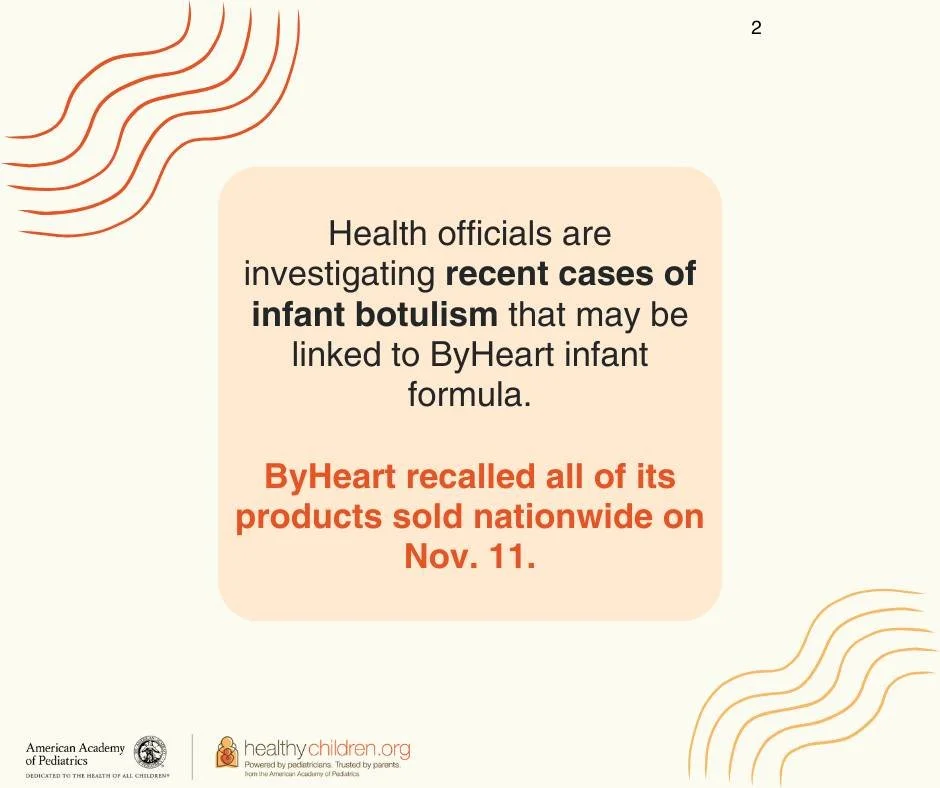
In November, ByHeart issued a voluntary recall of all its infant formula products sold nationwide after federal health officials began investigating several recent cases of infant botulism. Although only a small number of the reported cases have been linked to ByHeart products, the company and federal agencies acted quickly out of caution to protect families.

The recall affects all formula cans manufactured and distributed under the ByHeart brand. If you have ByHeart formula at home, stop using it immediately, but keep the can in case it needs to be tested later.

If your baby has consumed ByHeart formula recently, it’s important to monitor for symptoms of infant botulism — though it’s also important to remember that the vast majority of formula-fed infants remain perfectly healthy.

This recall affects a small portion of families, and most formula products on store shelves remain safe and reliable.

What Is Infant Botulism?

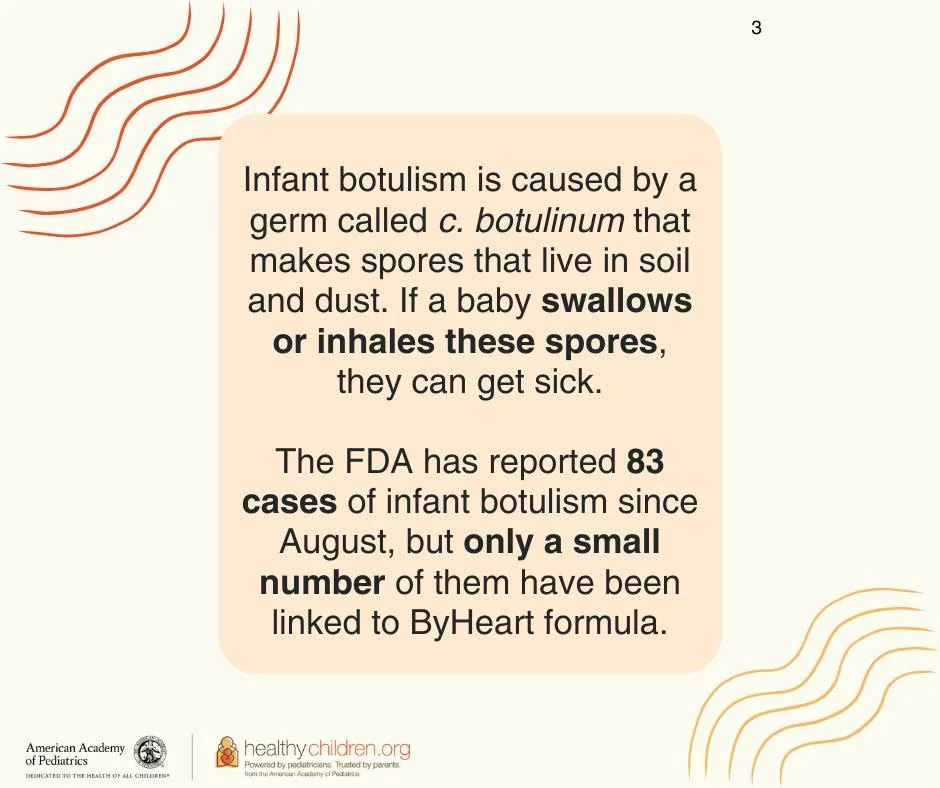
Infant botulism is a rare but serious condition caused by a germ called Clostridium botulinum. This bacterium produces spores that can live in soil, dust, and even on surfaces in the environment. When these spores are swallowed or inhaled, they can release a toxin that affects the nervous system.

In babies under 12 months old — whose digestive systems are still developing — these spores can multiply in the intestines and produce toxins that interfere with nerve signals. That’s what causes the muscle weakness and feeding difficulties that are hallmarks of the illness.

While infant botulism is rare, it requires careful monitoring and prompt medical attention when symptoms appear.

How Does Infant Botulism Happen?

The bacteria that cause infant botulism are naturally present in the environment, especially in soil, dust, and certain foods. Most people encounter them daily without getting sick, but infants are more vulnerable because their intestinal systems aren’t fully mature.

A few key ways exposure can happen include:

  • Environmental dust or dirt: Spores can be present in soil or carried through the air, especially in rural or agricultural areas.

  • Honey: This is a known risk for infants under one year old, which is why honey should never be given to babies younger than 12 months.

  • Contaminated formula or food: This is what health officials are investigating in relation to the ByHeart recall, though the connection is not yet fully confirmed.

Even though the FDA has reported around 83 cases of infant botulism since August, only a small fraction of these have been linked to ByHeart products. Still, it’s better to stay informed and prepared.

Symptoms of Infant Botulism

Because infant botulism affects the nervous system, it often causes symptoms that look like muscle weakness or fatigue. The signs can develop slowly over several days, so it’s important for parents and caregivers to watch carefully.

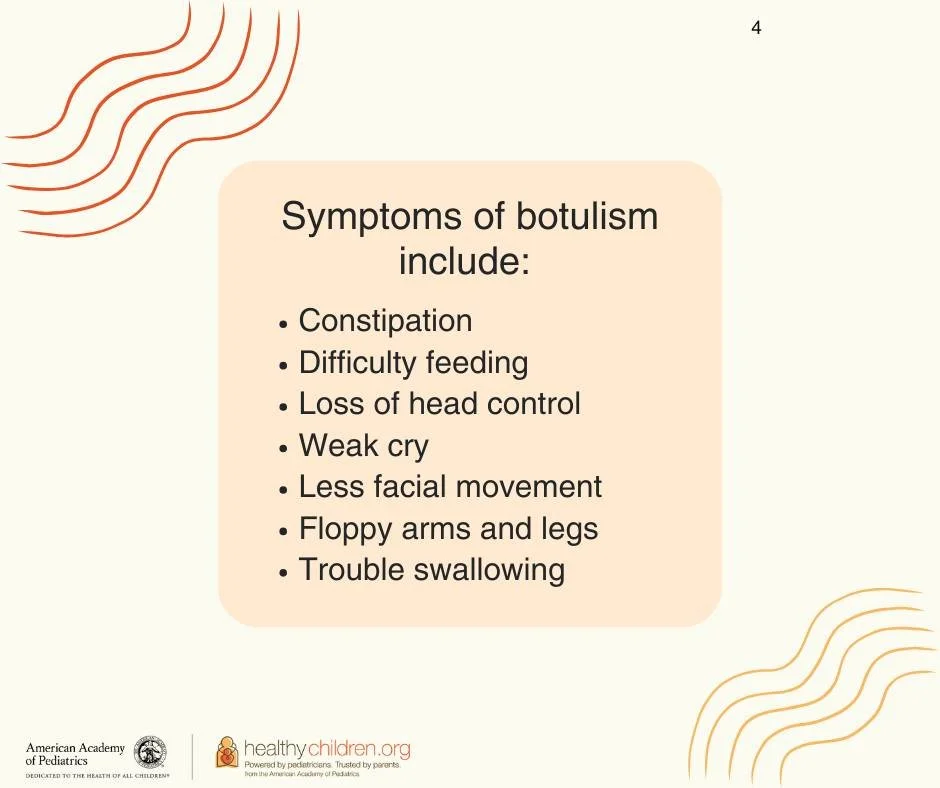
Common symptoms include:

  • Constipation (often the first sign)

  • Difficulty feeding or sucking

  • Weak cry

  • Floppy arms and legs

  • Loss of head control

  • Less facial movement or expression

  • Trouble swallowing or excessive drooling

  • Unusual fatigue or sleepiness

If your baby shows any of these symptoms — even mildly — call your pediatrician immediately. Early medical attention can make a major difference in recovery and outcome.

What To Do If You Have ByHeart Formula at Home

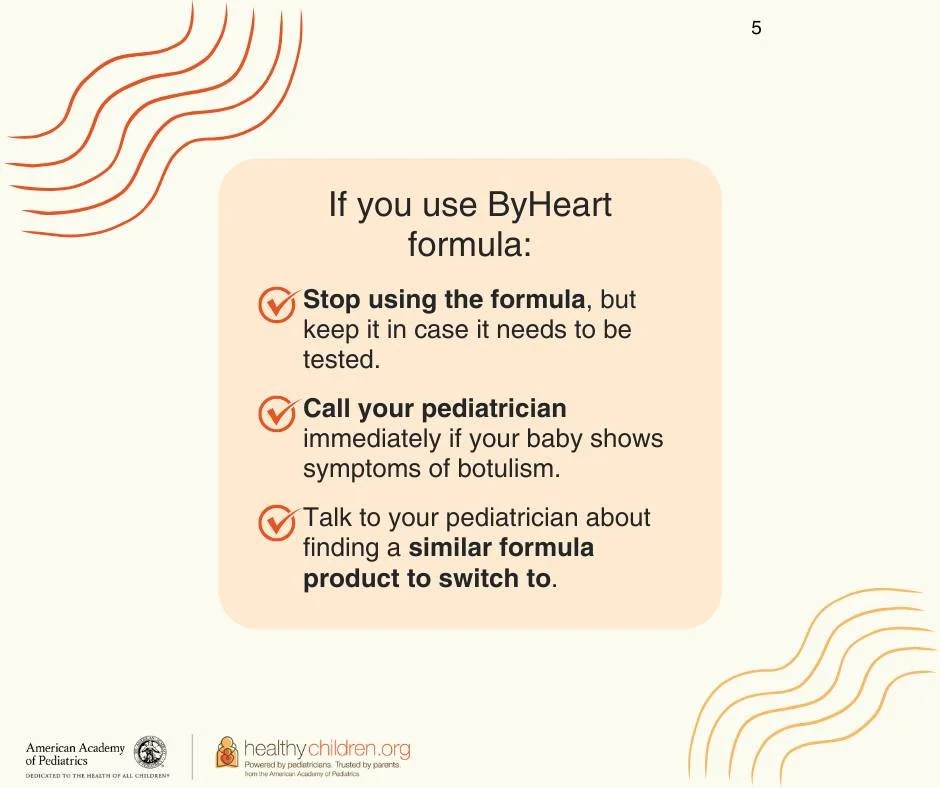
If your family has used ByHeart infant formula recently, here’s what health officials and pediatric experts recommend:

1. Stop using the formula immediately.

Do not continue feeding your baby from the recalled formula, even if they seem fine. However, don’t throw the can away — keep it sealed in a safe place in case it’s needed for testing later by the manufacturer or health officials.

2. Monitor your baby closely.

Watch for any of the symptoms listed above, including constipation, trouble feeding, or muscle weakness. Trust your instincts — if something feels off, it’s always worth calling your pediatrician.

3. Call your pediatrician right away if you have concerns.

If you notice any signs of illness, or if you simply want peace of mind, contact your doctor’s office immediately. The pediatric team can assess your baby’s condition, arrange for testing, and guide you through next steps if medical care is needed.

4. Switch to another formula safely.

Not all formulas are created exactly the same, but your pediatrician can help you choose an alternative that’s nutritionally comparable to ByHeart and gentle on your baby’s stomach. Always introduce new formula gradually to minimize digestive upset.

How Infant Botulism Is Treated

If diagnosed early, infant botulism can be treated effectively with specialized medical care. The standard treatment is a medication called BabyBIG® (Botulism Immune Globulin Intravenous) — a safe and highly effective therapy that neutralizes the botulinum toxin in the body.

Most infants treated promptly recover completely, though some may need short-term hospital care to help with feeding or breathing. The key is early recognition and immediate medical attention.

At The Children’s Clinic, our physicians coordinate with local hospitals and specialists to ensure your baby receives the best possible care, should treatment ever be necessary.

Understanding the Recall: What Parents Should Know

Recalls can be alarming, but they are also an important sign that safety systems are working as intended. When companies like ByHeart or agencies such as the FDA identify a potential risk, recalling the product is the right and responsible step to prevent harm.

It’s worth emphasizing that:

  • The recall is precautionary. Most formula products, including the majority of ByHeart cans sold, have not been directly linked to illness.

  • The vast majority of baby formula on the market is safe. Formula production is tightly regulated in the United States.

  • You are not alone. If you’re unsure whether your formula is affected, your pediatrician can help you verify batch numbers and identify safe alternatives.

Frequently Asked Questions from Parents

Is it safe to use other brands of formula?

Yes. Most baby formula on the market — from store brands to national labels — remains completely safe. The recall applies only to ByHeart products distributed before November 11.

How do I know if my can of formula is recalled?

You can check the ByHeart website or contact the company directly. You’ll need the lot number printed on the bottom of your formula can. If you’re unsure, bring the can to your pediatrician’s office, and our team can help confirm.

Can infant botulism spread between babies?

No. Infant botulism is not contagious. It develops inside the intestines when spores grow and release toxin, so one child cannot “give” it to another.

Should I sterilize bottles and nipples differently?

It’s always a good idea to wash and sterilize bottles, nipples, and formula scoops regularly. Use hot, soapy water and rinse thoroughly. While this doesn’t eliminate spores in contaminated formula, it helps reduce general bacterial exposure.

What should I feed my baby if I can’t find formula right away?

Do not attempt to make homemade formula or dilute formula with extra water. If you’re unable to find an immediate replacement, contact your pediatrician or local health department for safe alternatives and resources.

Reassurance for Parents

It’s understandable to feel uneasy when you see headlines about formula recalls or illnesses that affect infants. But it’s important to remember that cases like this are extremely rare, and health officials act swiftly to contain potential risks.

Most families who rely on formula can continue doing so with full confidence. Manufacturers, pediatricians, and public health agencies work together every day to ensure that infant nutrition products remain safe, regulated, and trustworthy.

If your baby is feeding well, alert, and showing no signs of illness, there’s no reason to panic. Simply verify your formula’s safety, keep an eye on your infant, and stay in touch with your pediatrician for reassurance.

Prevention Tips for Parents

You can take a few simple precautions to reduce your baby’s risk of exposure to C. botulinum spores:

  1. Avoid feeding honey to babies under 12 months old.

  2. Keep feeding equipment clean by washing bottles and nipples thoroughly after each use.

  3. Use formula according to label instructions, and discard any leftover formula after feeding.

  4. Store formula properly — tightly sealed in a cool, dry place.

  5. Talk to your pediatrician regularly about your baby’s feeding and digestive patterns.

These small habits go a long way toward keeping your baby safe and healthy.

When to Seek Immediate Medical Care

If your baby has consumed ByHeart formula and begins showing symptoms such as:

  • Persistent constipation

  • Difficulty feeding or swallowing

  • Weak or floppy arms and legs

  • Lethargy or excessive sleepiness

  • Trouble breathing

Call your pediatrician immediately or go to the nearest emergency room. The earlier treatment begins, the better the chances for a quick recovery.

Final Thoughts

Parenting in today’s world means staying alert to the latest news and recalls, but it also means finding balance — not letting fear take over when information spreads fast.

The ByHeart recall serves as an important reminder of why transparency and vigilance matter in the baby formula industry, but it’s equally important to know that these safety measures are working. Most baby formulas remain completely safe, and the steps being taken by federal health agencies show that potential issues are being caught early.

At The Children’s Clinic in Jackson, TN, we’re here to help families feel informed, supported, and confident. Whether you have questions about the recall, need to verify your formula, or want guidance on switching brands, our team is ready to assist.

Your child’s safety is our highest priority — and that includes peace of mind for parents.

📍 The Children’s Clinic
264 Coatsland Drive
Jackson, TN 38301

📞 Phone: 731-423-1500

Serving families throughout Jackson, Humboldt, Medina, Henderson, and West Tennessee, The Children’s Clinic offers compassionate pediatric care for every stage of childhood — from newborn wellness and vaccinations to feeding guidance and developmental checkups.

If you have questions about your baby’s formula or need personalized advice about the ByHeart recall, please don’t hesitate to reach out. Our doctors are always here to help you make informed, confident choices for your family.