
⭐ Raising Kids in a Digital World: How Parents in West Tennessee Can Model Healthy Screen Habits
Screens are part of everyday life—there’s no getting around it. Phones help us stay connected, organize our schedules, and sometimes even give us a moment of quiet when the day is overwhelming. But for kids, especially toddlers, school-age children, and teens, the way we use our devices sends a powerful message.
Children don’t just listen to what we say about screen time—
they copy what we do.
At The Children’s Clinic in Jackson, we often talk with parents from all over West Tennessee—Humboldt, Medina, Lexington, Milan—who want practical ways to help their kids build healthier boundaries with technology. And the truth is, the most effective strategies begin with small changes at home.
If you’ve ever caught yourself scrolling without thinking or using your phone as a buffer between tasks, you’re not alone. Parenting is exhausting, and sometimes a few minutes of quiet can feel like the only way to reset. But with a little intention, you can create healthier rhythms for yourself and your children.
Today, we’re breaking down simple, realistic ways to model a balanced relationship with screens—no guilt, no judgment, just guidance you can use.
⭐ Why Modeling Matters So Much
Kids absorb your habits long before they understand the reasoning behind them. If you’re on the couch after dinner scrolling while talking, or if your phone is always within arm’s reach, that becomes “normal” to your child.
And children—especially younger ones—don’t distinguish between work-related use and recreational use. To them, screen time is screen time.
When kids see adults:
Put phones down during meals
Take breaks from devices
Choose offline activities
Set limits for themselves
…it becomes much easier for them to follow similar expectations.
Healthy device habits are learned over time, and they start with consistent, honest modeling from the adults they trust most.
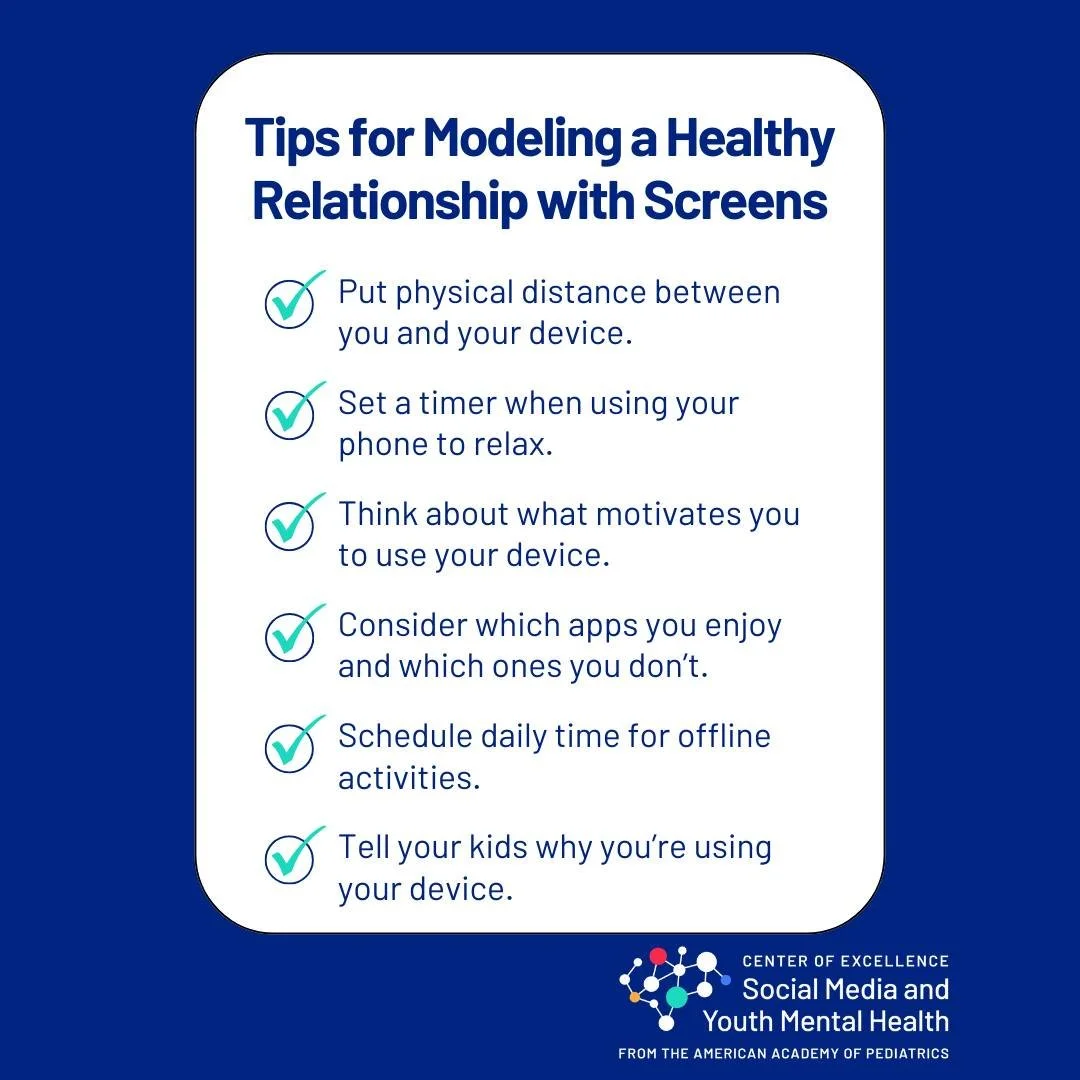
⭐ 6 Ways to Model a Healthier Relationship With Screens
Using guidance from pediatric mental health experts, here are easy, realistic changes that make a real difference in your home.
1. Put Some Physical Distance Between You and Your Phone
Small changes have a big impact.
Try placing your phone:
On a counter during meals
Across the room during family time
In your bag during sports practices
On a charger in a separate space at bedtime
Kids notice when your attention is actually on them—not split between conversation and a device.
2. Set a Timer When You Use Your Phone to Relax
Scrolling can be a way to unwind, and that’s okay. But without limits, a few minutes easily becomes twenty or thirty.
Set a simple goal:
Five or ten minutes with a timer
Then intentionally put the phone away
Your child sees you regulating your own usage, which helps them feel less alone when they’re asked to do the same.
3. Identify Why You Pick Up Your Device
Are you reaching for your phone because you’re bored? Stressed? Overstimulated? Uncertain what to do next?
Kids benefit tremendously from hearing adults talk through these moments.
Try narrating out loud:
“I’m feeling a little overwhelmed, so I’m taking a quick break.”
“I’m checking this because I need important information.”
“I’m putting my phone away because I want to focus on you.”
This teaches emotional awareness, not just rule-following.
4. Reflect on Which Apps Help You—and Which Drain You
Not all screen time is equal.
Some apps support connection, creativity, or organization. Others cause stress, comparison, or mindless scrolling.
Let your child hear you say:
“This app helps me learn new ideas.”
“This one makes me feel tired or distracted, so I’m deleting it.”
Kids learn media literacy from watching you evaluate your own digital habits.
5. Schedule Daily Offline Time—for You and Your Kids
Even 15–20 minutes of unplugged time makes a huge difference.
Examples that resonate with families in West Tennessee include:
Cooking dinner together
Walking around the neighborhood
Playing board games
Reading aloud
Doing small chores as a team
Shooting basketball outside
When kids see you choose offline activities, they learn to value them too.
6. Tell Your Kids Why You’re Using Your Device
Transparency builds trust.
Explain:
“I’m texting Grandma back.”
“I’m looking up the directions.”
“I’m responding to a work email, then I’m done.”
Kids are far more understanding when they see purpose, not constant distraction.
⭐ Why This Matters for Kids’ Mental Health
A recent study found that twelve-year-olds with smartphones had higher rates of:
Depression
Anxiety
Sleep disruption
Social comparison
Sedentary behavior
But here’s the good news—
Kids do better when families set healthy boundaries together.
When parents model balanced habits:
Children sleep better
Family communication improves
Kids feel more grounded
Screen time causes fewer arguments
Technology becomes a tool—not a takeover
And your presence—your real, in-the-room attention—is something no app can replace.
⭐ Practical Ways to Start Today
Here are a few simple shifts parents in Jackson and the West TN area have found helpful:
✔ Create a charging station outside the bedroom
✔ Make the car a phone-free zone
✔ Have one or two screen-free meals each day
✔ Use “Do Not Disturb” during family time
✔ Replace end-of-day scrolling with a short walk
✔ Encourage kids to help decide the family rules
These moments build connection and resilience, setting a foundation your child carries into adolescence and adulthood.
⭐ If You’re Struggling, You’re Not Alone
Parenting in the digital age is complicated—even for pediatricians. No one gets it perfect. What matters is awareness, intention, and connection.
If you ever feel unsure, or if you’re worried about your child’s screen habits, sleep, mood, or behavior, our team at The Children’s Clinic is here to help. We support families through every stage of development and can help you create a plan that works for your household.
You don’t have to figure this out alone.
⭐ The Children’s Clinic — Proudly Serving Families Across West Tennessee
📍 264 Coatsland Drive, Jackson, TN 38301
📞 731-423-1500
Caring for children and teens throughout Jackson, Medina, Humboldt, Milan, Lexington, Pinson, and the greater West TN region.
Learn more: https://bit.ly/493RE4x
