
Vaccines, Autism & the Truth Parents Deserve: What Families in West Tennessee Should Know
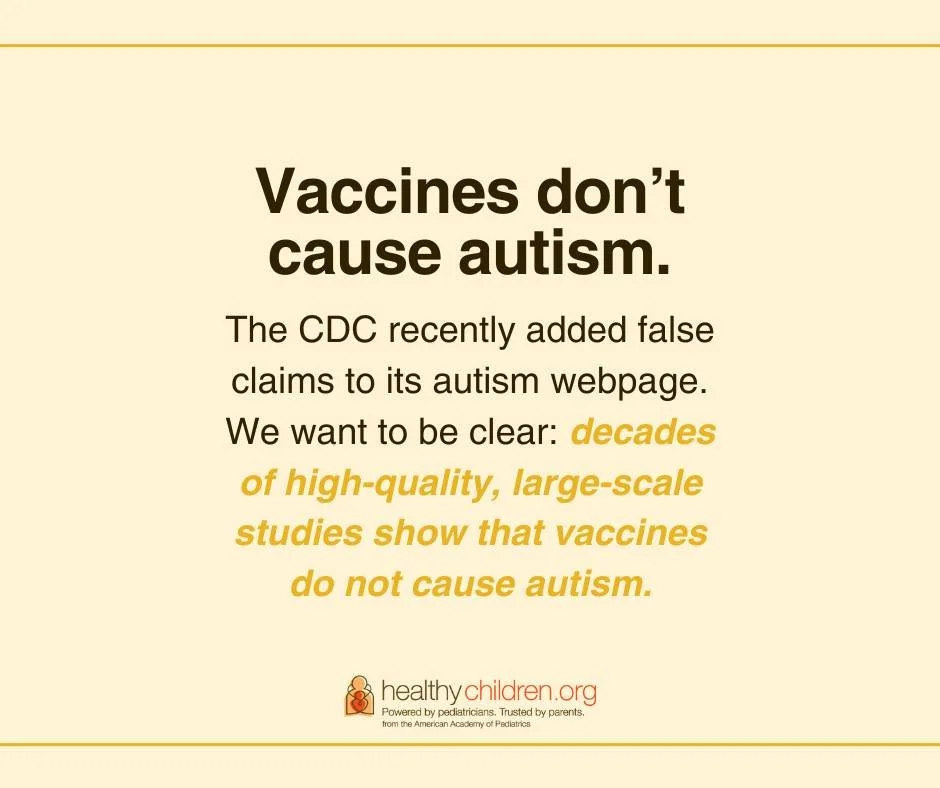
Over the past few weeks, many parents across West Tennessee have reached out with the same question: “I heard the CDC shared something confusing about autism and vaccines—what does that mean for my child?”
It’s a reasonable question. Any time a major health organization publishes something that sounds unclear or contradicts years of medical guidance, families feel unsettled. Parenting is filled with enough worry already—nobody needs extra confusion about something as important as vaccines.
At The Children’s Clinic in Jackson, TN, we believe parents deserve calm, clear, and reliable information. And when it comes to vaccines and autism, the research has been consistent for decades: vaccines do not cause autism. That’s not an opinion. It’s not a trend. It’s not something that changes with a single online post. It is the conclusion of decades of careful, large-scale, peer-reviewed research involving millions of children around the world.
So let’s talk about what happened, why it matters, and how parents can move forward with confidence.
What Sparked the Concern?
Recently, the U.S. Centers for Disease Control and Prevention (CDC) added wording to one of its autism webpages that left room for misunderstanding. It wasn’t an official change to medical guidance. It wasn’t new evidence. It wasn’t based on updated science.
But it was vague enough to give the false impression that scientists were reconsidering the connection between vaccines and autism.
Parents noticed. Autism advocates noticed. Pediatricians across the country noticed. And the concerns grew quickly, especially online where misinformation spreads rapidly.
However, leading medical experts—including the American Academy of Pediatrics (AAP)—responded immediately. Their message was direct and reassuring:
Vaccines do not cause autism. They have never been shown to cause autism. The science on this is overwhelming.
Dr. Susan Kressly, president of the AAP, put it simply:
“Parents deserve peace of mind. Decades of rigorous research have shown vaccines do not cause autism.”
This statement echoes what pediatricians, neurologists, developmental specialists, and autism researchers have been saying for years.
How We Know Vaccines Don’t Cause Autism
Parents deserve more than a simple answer—they deserve to understand why the medical community is so confident.
Over the past several decades, scientists have examined this question from every angle imaginable:
Extremely large population studies comparing vaccinated children to unvaccinated children
Long-term developmental tracking
Genetic research
Neurological studies looking at how autism develops in the brain
Reviews of vaccine ingredients
Studies across different countries, ages, and health systems
Across all of that research, the result is always the same:
There is no link between vaccines and autism.
Not a weak link. Not a questionable link. Not a “possible” link.
No link.
Autism is a complex neurological condition with roots in early brain development, likely influenced by genetics and other non-vaccine-related factors. It does not come from vaccines, and it never has.
Where the Original Myth Came From
The idea that vaccines cause autism didn’t come from scientific discovery. It came from a single, deeply flawed paper published in 1998 that falsely claimed a connection between the MMR vaccine and autism.
That paper was later found to contain falsified data and undisclosed financial conflicts of interest. The journal that published it fully retracted it. The doctor behind it lost his medical license.
Yet, the rumor continued to spread—because fear spreads faster than facts.
Parents who lived through that era often still remember the headlines, even after the truth came out. This is why pediatricians have worked so hard to correct the misinformation. And why the AAP is pushing back once again today.
Why the AAP Spoke Up Now
The American Academy of Pediatrics, which represents over 67,000 pediatricians across the country, quickly responded to the recent CDC website issue. They issued a strong public statement reaffirming scientific evidence and expressing solidarity with the autism community.
The AAP made it clear:
- Vaccines do not cause autism
- Parents deserve accurate information
- Misinformation harms families and undermines health
Families who have autistic children have also been vocal about their frustration with vaccine myths. Many feel the rumor distracts from real support needs, real therapies, and real advocacy for autistic individuals.
The AAP has listened—and stood beside them.
Why This Matters for Families in West Tennessee
In communities like Jackson, Medina, Humboldt, Henderson, and the surrounding areas, parents rely heavily on trusted local providers. Most families want to do the right thing for their children. They don’t want to take unnecessary risks. They don’t want to skip something important. But they don’t want to be misled, either.
So when a national agency posts something confusing, it’s normal for families to ask questions.
At The Children’s Clinic, we want you to hear the reassurance directly:
Nothing has changed. Vaccines are still safe, recommended, and essential for keeping children healthy.
Vaccines protect children from illnesses that once caused severe complications, hospitalizations, and deaths.
They keep our West Tennessee schools healthier.
They protect newborns who are too young to be vaccinated.
They protect children with compromised immune systems.
They keep our hospitals from overwhelming winter surges.
Vaccines are one of the most successful public health tools we have ever had.
How Pediatricians Approach Autism Today
One of the reasons the vaccine myth is so harmful is that it distracts from what really supports autistic children: early identification, understanding, and proper services.
Autism is not a tragedy. It’s not something to blame on vaccines. It’s a neurodevelopmental difference—one that many children and adults navigate confidently with the right support.
Today’s pediatric care focuses on:
Early developmental screening
Listening to parents’ observations
Supporting children’s strengths
Connecting families with therapy and resources
Creating inclusive, accessible environments
Advocating for education and community support
When the public clings to myths, it hurts autistic individuals by perpetuating stigma or dismissing their lived experiences.
This is why the AAP and autism advocates were so quick to call attention to the misleading CDC wording—because correcting misinformation benefits every family.
Why Vaccine Confidence Matters Now More Than Ever
We live in a time when information travels fast, but not always accurately. One mistaken phrase, taken out of context, can spread across social media before experts have a chance to correct it. And when misinformation spreads about vaccines, it impacts everyone.
In recent years, we have seen:
Measles outbreaks in communities with low vaccination rates
Whooping cough resurgences
Influenza seasons affecting younger children more severely
RSV and viral surges leading to overwhelmed pediatric hospitals
Vaccines remain the most reliable way to protect children from these threats. When families hesitate because of misinformation, entire communities become more vulnerable.
That’s why having trusted, science-based support from pediatricians matters so much—especially in regions like West Tennessee, where families rely heavily on local providers and relationships built on trust.
Talking to Your Pediatrician Should Always Be the First Step
If you are unsure, confused, or simply want reassurance, your pediatrician is the best person to talk to. They know your child, your family, your concerns, and the health trends in our area.
At The Children’s Clinic in Jackson, we welcome every question. Nothing is too small, too specific, or too repetitive. Whether you want to discuss the vaccine schedule, ingredients, safety studies, autism research, or your child’s development, our team is here to guide you.
You deserve answers based on evidence—not rumors. And you deserve those answers from someone who knows your family.
Final Thoughts: Parents Deserve Peace of Mind
Parents today make hundreds of decisions a week. Some are small. Some feel enormous. Vaccines shouldn’t have to be a source of fear or confusion.
The science is clear and reassuring.
The experts are united.
Your pediatricians stand firmly behind the evidence.
And your community—especially the autism community—deserves better than misinformation.
Vaccines do not cause autism.
They protect children.
They save lives.
And they help our West Tennessee families thrive.
If you ever have questions, we are here to help—always.
📍 The Children’s Clinic
264 Coatsland Drive
Jackson, TN 38301
📞 731-423-1500
Proudly caring for families across Jackson, Medina, Humboldt, Henderson, Lexington, and the greater West Tennessee region.
