
Building a “Calm Toolbox”: Healthy Ways to Help Kids (and Parents) Cope with Stress in Jackson, TN
Life can be stressful — for adults and children alike.
Busy schedules, school pressures, social challenges, and constant digital notifications can leave families feeling overwhelmed. When emotions run high, it’s easy to reach for a screen as a quick distraction.
But screens aren’t the only — or always the best — solution.
At The Children’s Clinic in Jackson, TN, we encourage families across Madison County and West Tennessee to build what we call a “Calm Toolbox.” These are simple, healthy activities that help regulate the nervous system and provide positive distractions when big feelings take over.
Let’s explore how it works.
Why We Need a Calm Toolbox
When we feel stressed, our nervous system shifts into “fight or flight” mode. For children, this might look like:
Meltdowns
Irritability
Trouble focusing
Crying or withdrawal
Difficulty sleeping
For adults, it can show up as tension, impatience, headaches, or exhaustion.
Screens may temporarily distract us, but they don’t always calm the nervous system. In some cases, fast-paced content can actually increase stimulation.
A calm toolbox gives both parents and children intentional, healthy ways to reset.
What Is a Calm Toolbox?
A calm toolbox is simply a collection of activities that:
✔ Redirect attention
✔ Slow the body down
✔ Encourage focus
✔ Support emotional regulation
✔ Create connection
These activities are meant to be positive distractions — not avoidance, but tools that help the brain and body settle so problem-solving becomes possible.
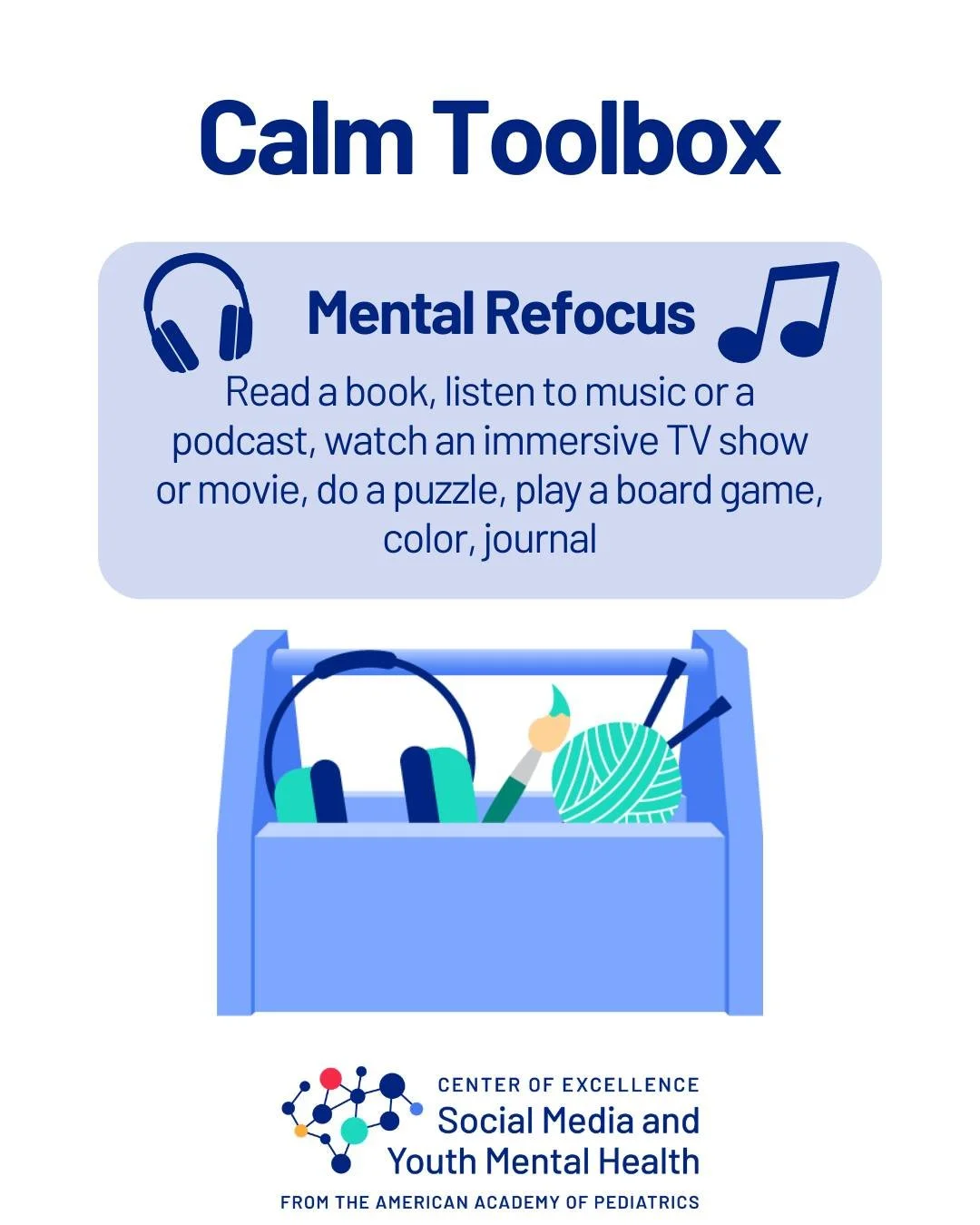
Calm Toolbox Idea: Mental Refocus
One of the easiest ways to regulate stress is through mental refocusing activities.
These include:
Reading a book
Listening to calming music
Playing a favorite podcast
Watching an immersive, slow-paced show or movie
Doing a puzzle
Playing a board game
Coloring
Journaling
These activities engage the brain in structured, predictable ways. That predictability helps calm the stress response.
For families in Jackson, Medina, Humboldt, and throughout West Tennessee, these are simple tools that can be used at home, in the car, or even during busy evenings.
Why These Activities Work
When we focus on a puzzle, a story, music, or creative work, several helpful things happen:
Breathing slows
Heart rate stabilizes
Muscles relax
Attention narrows to one task
Emotional intensity decreases
For children especially, hands-on activities like coloring, drawing, or board games give their brains something concrete to anchor to.
This shift helps move the body out of fight-or-flight and back into a calmer state.
Screens vs. Intentional Screen Use
Not all screen time is harmful. The key is intentional use.
If a child is already overstimulated, fast-moving videos or social media scrolling may increase emotional reactivity.
Instead, choose:
Slower-paced programming
Educational or story-based shows
Shared screen time with conversation
Better yet, balance screen use with non-digital calming tools.
How to Create a Calm Toolbox at Home
You can build a physical or mental calm toolbox with your child.
Here’s how:
Sit down together when everyone is calm.
Ask: “What helps you feel better when you’re upset?”
Write down ideas.
Gather simple supplies — books, coloring pages, puzzle books, a favorite playlist, journals.
Keep them in an accessible spot.
The goal is to practice using these tools before emotions get overwhelming.
Over time, children learn to recognize when they need a reset — and reach for healthy strategies on their own.
Modeling Calm as a Parent
Children learn emotional regulation by watching adults.
If your child sees you:
Taking a break to read
Listening to music to unwind
Journaling
Playing a board game instead of scrolling
They begin to understand that calming strategies are normal and healthy.
Parents in Jackson often tell us they feel pressure to always “have it together.” But modeling calm doesn’t mean being perfect — it means showing your child how to cope in real time.
When to Seek Extra Support
Occasional stress is normal.
However, if your child experiences:
Frequent intense meltdowns
Persistent anxiety
Trouble sleeping
Avoidance of school
Significant mood changes
It may be time to talk with your pediatrician.
At The Children’s Clinic in Jackson, TN, we support children’s physical and emotional health. We can help you evaluate stress patterns and guide you toward additional support if needed.
Start Small
You don’t need a complicated plan.
Start with:
One book
One puzzle
One journal
One playlist
Small tools can make a big difference.
Because helping children build healthy coping skills today sets them up for resilience tomorrow.
The Children’s Clinic
264 Coatsland Drive
Jackson, TN 38301
📞 731-423-1500
Serving families across Jackson, Madison County, and West Tennessee.
